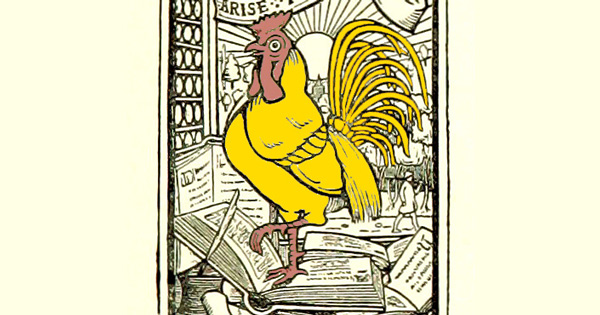
Derby Fizzes, Gin Daisies, Harvard Coolers, and other Prohibition-era treats for your next dinner party.
For all its blessings and fascinations, retromania is easily at its most delicious when it comes to vintage food and drink, from the cocktails of Mad Men to yesteryear’s bizarre food concoctions. But there’s hardly a better way to add some vintage class to your life than with the Savoy Cocktail Book — a compendium of drink recipes from the 1920s and 30s when Prohibition-dodging Americans visited London’s iconic Savoy bar for “tea-dances” and “mixed drinks” shaken and stirred by iconic American barman Harry Craddock, who invented the White Lady and popularized the Dry Martini. Originally published in 1930, the book features 750 of Craddock’s most beloved recipes, from Slings to Smashes, Fizzes to Flips, alongside stunning art-deco illustrations that capture the era’s elegance and sophistication.
Currently out of print but snaggable used on Amazon, the Savoy Cocktail Book is at once a priceless time-capsule of a long-gone era and a powerful weapon for impressing your guests at your next dinner party.
Brain Pickings has a free weekly newsletter and people say it’s cool. It comes out on Sundays and offers the week’s best articles. Here’s an example. Like? Sign up.
From Homer to John Lennon, or what the “psychedelic 60s” can teach us about creativity in animation.
Animated music videos are about as common today as photos of cats on the internet and, tragically often, not that much more original. But there was a time when they were a pinnacle of creative innovation, breaking entirely new ground. Earlier this year, we looked at the work of 5 early animation pioneers who changed the course of animated storytelling, and today we turn to the intersection of film and music with Mod Odyssey, a fascinating featurette on the making of The Beatles’ groundbreaking 1968 animated feature film, Yellow Submarine. More than a decade before Pixar, the film was not only a technical feat of animation execution but also a seminal work in bringing more attention to animation as a serious art form, both for audiences and for creators.
For the first time in screen history, extremely real and enormously famous people were going to be animated into a feature film.”
‘Yellow Submarine’ breaks new ground in the art of animation. Just as Swift and Carroll changed the history of literature, as Chagall and Picasso brought new life to art, The Beatles are revitalizing the art of animation. It’s a truly mod world, where medium and message meld — the new art of the psychedelic 60s.”
For more on animating Lennon, don’t forget the excellent and timeless I Met The Walrus, recorded the year after Yellow Submarine and animated 39 years later.
Brain Pickings has a free weekly newsletter and people say it’s cool. It comes out on Sundays and offers the week’s best articles. Here’s an example. Like? Sign up.
Insights on identity and the aberrations of authority from the most notorious psychology experiment of all time.
Forty years ago today, the Stanford Prison Experiment began — arguably history’s most notorious and controversial psychology experiment, which gleaned powerful and unsettling insights into human nature. Orchestrated by Stanford researcher Philip Zimbardo, the study randomly assigned 24 middle-class college-aged males, recruited via newspaper classifieds and pre-screened to have no mental health issues or criminal history, to the roles of prisoners and prison guards in a hyper-realistic simulated prison environment. Though the guards were instructed to under no circumstances harm the prisoners physically, they were encouraged to think of themselves as actual prison guards and instill in the inmates a sense of powerlessness, frustration and “arbitrariness,” to make them fully believe that their lives were controlled entirely by “the system” and that they had no freedom of action whatsoever.
What followed was a devastating manifestation of the human capacity for cruelty and evil, so powerful and dehumanizing that the researchers had to end the two-week experiment after the sixth day. What’s most striking about the study is that all the participants were “normal” young men, yet they came to identify with their assigned roles so deeply that their behavior and entire personalities morphed to unrecognizable extremes, molded after the expectations of the respective role.
The study makes a very profound point about the power of situations — that situations affect us much more than we think, that human behavior is much more under the control of subtle situational forces, in some cases very trivial ones, like rules and roles and symbols and uniforms, and much less under the control of things like character and personality traits than we ordinarily think as determining behavior.” ~ Philip Zimbardo
Quiet Rage is a fascinating 1992 documentary about the SPE, written by Zimbardo himself and featuring archival footage of the actual experiment as well as interviews with the prisoners and guards conducted shortly after the study’s premature end. The 50-minute film is available online in its entirety — prepare to be hopelessly uncomfortable with both the experiment itself and the debriefing, which starts at around minute 32.
I really thought I was incapable of this kind of behavior, I was really dismayed that…I could act in a manner so absolutely unaccustomed to anything I would ever really dream of doing. And while I was doing it, I didn’t feel any regret, I didn’t feel any guilt. It was only afterwards, after I began to reflect on what I had done that this began to dawn on me and I realized that this was a part of me I hadn’t really noticed before.” ~ Mock Guard
I began to feel that I was losing my identity, that the person that I called Clay, the person who volunteered to go into this prison…was distant from me, was remote, until, finally, I wasn’t that. I was 416, I was really my number. And 416 was gonna have to decide what to do.” ~ Mock Prisoner
Though the experiment was essentially about how authority and power dynamics affect our capacity for evil, it’s also a powerful demonstration of a great many human psychological liabilities, from bystander effect as third-parties like parents, the priest, and even the researchers themselves accepted the prison as a prison rather than an experiment, failing to intervene and end suffering, to in-group-out-group bias as the inmates singled out the new replacement prisoner and began to treat him as a vilified “other,” to the painful cognitive dissonance of the guards, trying to later reconcile their atrocious actions during the experiment with beliefs they had about who they were as persons and as human beings.
It’s important not to think of this as prisoner and guard in real prison. The important issue is the metaphor ‘prisoner’ and ‘guard’ — what does it mean to be a prisoner, what does it mean to be a guard. And a guard is someone who limits the freedom of someone else, who uses the power in their role to control and dominate someone else, and that’s what the study is about.” ~ Philip Zimbardo
The study, as rattling and uncomfortable as it was, has connotations for everything from prison reform to conformity to self-improvement to violence, bullying and hate crime. For further insights from it, see Zimbardo’s excellent The Lucifer Effect: Understanding How Good People Turn Evil. Curiously, Zimbardo has since set out to explore the human condition from the opposite end of the good/evil spectrum, launching the Heroic Imagination Project — an effort to harness what psychology knows in advancing everyday heroism and the perpetration of good rather than evil.
Another documentary about the SPE, The Evilness of Power, is available for free on The Internet Archive. Here’s a short excerpt, in which Zimbardo discusses the key takeaways from the study:
Above all, the SPE is a powerful case study in how easily we become identified with the roles and personas that have been assigned to us — by society, by our peers’ or parents’ or partners’ expectations, by our political leaders, and, perhaps most powerfully, by us ourselves. As soon as we begin to see ourselves as a “prisoner” or a “guard” (or a lawyer, or an alcoholic, or a victim, or a genius), we begin to act as one. Gandhi, it seems, had it right after all:
Brain Pickings has a free weekly newsletter and people say it’s cool. It comes out on Sundays and offers the week’s best articles. Here’s an example. Like? Sign up.
Brain Pickings remains ad-free and takes 450+ hours a month to curate and edit, between the site, the newsletter, and Twitter. If you find any joy and value in it, please consider a modest donation.
newsletter
Brain Pickings has a free weekly newsletter and people say it's cool. It comes out on Sundays and offers the week's best articles. Here's an example. Like? Sign up.