Brain Pickings

Posts Tagged ‘Maurice Sendak’

09 MAY, 2012

Grim Colberty Tales: Maurice Sendak’s Last Video Appearance

By:

“I don’t write for children. I write — and somebody says, ‘That’s for children!’”

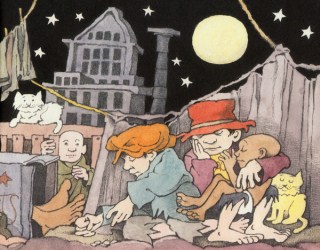
The world is a little dimmer this week at the news that Maurice Sendak has died at the age of 83, he who gave us such cultural treasures as Where The Wild Things Are and such hidden gems as these little-known Velveteen Rabbit illustrations. It is perhaps some kind of cosmic joke that this week also marks the release of Stephen Colbert’s first children’s book, I Am A Pole (And So Can You!), which features possibly the best book blurb of all time, by none other than Sendak himself:

The sad thing is, I like it.

In this two-part interview titled Grim Colberty Tales with Maurice Sendak, recorded in January 2012, Sendak makes his last known video appearance and banters with Colbert, lucid and wryly witty as ever, about everything from the state of children’s literature today to the free market to being gay.

COLBERT: Why do you write for children?

SENDAK: I don’t write for children. I write — and somebody says, ‘That’s for children!’ I didn’t set out to make children happy or make life better for them, or easier for them.

COLBERT: Do you like them?

SENDAK: I like them as few and far between as I do adults — maybe a bit more, because I really don’t like adults at all.

Maurice Sendak (left) and Stephen Colbert draw a pole. Sendak's drawing, true to his signature wit, depicts a Polish woman holding a pole.

In the second part, Colbert reads from I Am A Pole (And So Can You!) and gets a drawing lesson from Sendak.

COLBERT: What does it take for a celebrity to make a successful (children’s) book, what do I gotta do?

SENDAK: You’ve started already by being an idiot. That is the very first demand.

Top photo via MSNBC

Brain Pickings has a free weekly newsletter and people say it’s cool. It comes out on Sundays and offers the week’s best articles. Here’s what to expect. Like? Sign up.

23 MARCH, 2012

The Secret Art of Dr. Seuss

By:

“…a creature content with himself as animal and artist, and one who didn’t give a lick or a spit for anyone’s opinion, one way or another, of his work.”

When we celebrated the 108th would-be birthday of Dr. Seuss earlier this month with his little-known book of nudes, reader Jennifer Alluisi flagged a fascinating deeper dive into Geisel’s more obscure creations — The Secret Art of Dr. Seuss, originally published in 1995, collects 65 of Geisel’s whimsical paintings, sculptures, and rough sketches of weird and wonderful beings in otherworldly settings, created for his own pleasure and never exhibited in public. Though Geisel’s most enduring legacy remains his timeless children’s literature, this volume sheds new light on his contribution to contemporary art — a realm he approached with the same blend of idiosyncratic talent and uncompromising dedication that made him a cultural icon in his “other life.”

A Seuss drawing suggesting that no matter how big, inflated or different the image we try to portray, being ourselves is most important.

TM & © 1995 Dr. Seuss Enterprises, L. P., Secret Art Collection, courtesy of the Museum of Science and Industry

For an added treat, the introduction was penned by none other than the great Maurice Sendak, who writes:

I retain a most vivid picture of Ted standing in his studio before his easel, palette in hand, brush poised. He would lean forward and then back on his heels, head cocked to one side and then to the other. The artistic ‘dance’ step was repeated over and over again.

He enjoyed working after midnight — seldom during the working-day hours. He did not consider painting to be ‘work,’* so it had to wait till late at night. Painting was what he did for himself and not something he felt comfortable in sharing.

[…]

I remember telling Ted that there would come a day when many of his paintings would be seen and he would thus share with his fans another facet of himself — his private self. That day has come. I am glad.

'Pink-Tufted Small Beast in Night Landscape,' 1960

TM & © 1995 Dr. Seuss Enterprises

'The Stag at Eve,' 1960

TM & © 1995 Dr. Seuss Enterprises

Sendak captures Geisel’s remarkable character:

The Ted Geisel I knew was that rare amalgamation of genial gent and tomcat — a creature content with himself as animal and artist, and one who didn’t give a lick or a spit for anyone’s opinion, one way or another, of his work. He was, of course, immensely charming and polite about the whole matter, but when Ted fixed you with his calm cat-gaze, you knew when to shut up. It was easy to respect the simple honesty and curious privacy behind the gentle bluster of the man, but Seuss’s apparent lack of interest in style, fashion, and any kind of analysis relating to his work astonished me. Only after years of friendship was I completely won over; Dr. Seuss was serious about not being ‘serious.’**

'Peru 1 (Giant Llama Led Through Village), 1925

TM & © 1995 Dr. Seuss Enterprises

'Peru 2 (Vultures Waiting for the Fall), 1925

TM & © 1995 Dr. Seuss Enterprises

'Peru 3 (Cock Fight), 1925

TM & © 1995 Dr. Seuss Enterprises

'Peru 4 (Angry Pig), 1925

TM & © 1995 Dr. Seuss Enterprises

Zachery

TM & © 1995 Dr. Seuss Enterprises

'The Manly Art of Self-Defense,' 1927

TM & © 1995 Dr. Seuss Enterprises

Untitled

TM & © 1995 Dr. Seuss Enterprises

Untitled

TM & © 1995 Dr. Seuss Enterprises

Of Seuss’s art in general and the works collected in The Secret Art of Dr. Seuss in particular, Sendak writes:

There was certainly nothing cookie-cutter, bland, or trendy about Ted Geisel. These works abound in nuttiness, ‘political incorrectness,’*** and lots and lots of cats. In short, you have entered Seussville, where questions and doubts are left at the door with the coo-coo something-or-other. Enjoy yourself.

* See Lewis Hyde on work vs. creative labor

** See Paula Scher’‘s TED talk on serious vs. solemn design

*** For the radical politics and political incorrectness of iconic children’s authors, see Tales for Little Rebels

Brain Pickings has a free weekly newsletter and people say it’s cool. It comes out on Sundays and offers the week’s best articles. Here’s what to expect. Like? Sign up.

24 FEBRUARY, 2012

A Brief History of Children’s Picture Books and the Art of Visual Storytelling

By:

From cave paintings to Maurice Sendak, or what modern ebooks can learn from mid-century design icons.

Back in the fifteenth century, Leonardo da Vinci made the following remark about visual storytelling:

And you who wish to represent by words the form of man and all the aspects of his membrification, relinquish that idea. For the more minutely you describe the more you will confine the mind of the reader, and the more you will keep him from the knowledge of the thing described. And so it is necessary to draw and to describe.”

Finished artwork for Ajubel's Robinson Crusoe.

From very early on, we both intuit and learn the language of pictorial representation, and most modern adults, the picturebook was our first dictionary of this visual vocabulary. Yet the picturebook — defined by its narrative framework of sequential imagery and minimalist text to convey meaning or tell a story, and different from the illustrated book in which pictures play a secondary narrative part, enhancing and decorating the narrative — is a surprisingly nascent medium.

In Children’s Picturebooks: The Art of Visual Storytelling, illustrator Martin Salisbury and children’s literature scholar Morag Styles trace the fascinating evolution of the picturebook as a storytelling medium and a cultural agent, and peer into the future to see where the medium might be going next, with case studies of seminal works, a survey of artistic techniques, and peeks inside the sketchbooks and creative process of prominent illustrators adding dimension to this thoughtful and visually engrossing journey.

Though pictorial storytelling dates back to the earliest cave wall paintings, the true picturebook harks back to a mere 130 years ago, when artist and illustrator Randolph Caldecott (1846-1886) first began to elevate the image into a storytelling vehicle rather than mere decoration for text. Maurice Sendak, widely regarded as the greatest author of visual literature (though he refuses to identify as a “children’s author”), once wrote of Caldecott’s “rhythmic syncopation” and its legacy:

Caldecott’s work heralds the beginning of the modern picture book. He devised an ingenious juxtaposition of picture and word, a counter point that never happened before. Words are left out — but the picture says it. Pictures are left out — but the words say it. In short, it is the invention of the picture book.”

Even early on, tensions between the creative vision and marketability of picturebooks captured the same friction between artist-storyteller and publisher that continues to plague children’s — if not all — publishing. Walter Crane (1845–1915), another Victorian-era picturebook innovator, famously grumbled about printer-publisher Edmund Evans’ approach to publishing:

“…but it was not without protest from the publishers who thought the raw, coarse colours and vulgar designs usually current appealed to a larger public, and therefore paid better…”

(Evans, per Crane’s remark, seemed to have taken on the role of a “circulation manager” of books, and with that came the same perception of compromised editorial integrity we’ve previously seen in the context of newspapers.)

Lewis Carroll's The Mouse's tale is an early example of text taking the visual form of that which it describes or alludes to.

But the picturebook didn’t fully blossom until the late nineteenth and early twentieth century, when new developments in printing technology, changing attitudes towards childhood, and a new class of exceptional artists catapulted it into a golden age. The first three decades of the twentieth century germinated such timeless classics as Curious George and the Babar stories. But as war consumed Europe, resources dwindled and the paper shortages of the post-war era placed new demands for keeping publishing costs low. Yet despite, or perhaps because of, the austerity of the time, there was a profound longing for color as escapism, which reined in the neo-romantic movement.

Then, in the 1950s, a peculiar cultural shift began to take place — the line between artist and author started to blur, and a crop of famous graphic designers set out to write and illustrate picturebooks as a way of exploring visual thinking. (Just this week, one of the most celebrated such gems, the only children’s book by the great Saul Bass, resurfaced to everyone’s delight.) Among the highlights of this new frontier was a series of children’s picturebooks by legendary graphic designer — and, paradoxically, notorious curmudgeonPaul Rand.

He and his then-wife, Ann, produced Sparkle and Spin (1957), Little 1 (1962), and Listen! Listen! (1970), all an exercise in demonstrating “a playful but sophisticated understanding of the relationship between words and pictures, shapes, sounds, and thoughts.” (It was in the same period that Italian novelist and philosopher Umberto Eco introduced young readers to semiotics, the study of signs and symbols.)

André François's Crocodile Tears (Universe Books NY, 1956) uses an extreme landscape format to reflect and emphasize the subject matter. It was François's first picturebook as author-artist.

In Um Dia Na Praia flat color without line is used with careful attention to the placement of every element in order to develop a wordless text. The very simple shapes need to carry the entire weight of a subtle pictorial narrative.

But many of these pioneering picturebook storytellers, just like Sendak does to this day, had an aversion to identifying as “children’s book” authors. Salisbury and Styles write:

Of course, many of the best picturebook artists would not describe themselves exclusively as such. André François was born in Hungary, in an area that became part of Romania after World War I. But it was as a French citizen that he spent his working life as a graphic artist, spanning visual satire, advertising and poster design, theater set design, sculpture, and book illustration. François’s work exhibited a childlike awkwardness that belied a highly sophisticated, biting eye.”

(Sound familiar?)

In the 1960s, as a generation of British artists emerged from art school, picturebooks entered a new era of vibrant paint and color, with many artists combining book illustration and painting to make a living. (Including, as we’ve seen, Andy Warhol.) It was in that era that some of the most influential picturebooks were born, including Maurice Sendak’s most beloved work and Miroslav Šašek’s timeless This Is… series.

Miroslav Sasek's 'This is…' series introduces children to countries and cities around the world. What distinguished them from many such books was the artist's eye for the anecdotal detail of different cultures. This is London was published by MacMillan in 1959.

(Don’t miss Šašek’s lesser-known 1961 gem, Stone Is Not Cold, in which he brings to life famous sculptures from London, Rome and the Vatican City in irreverent vignettes from everyday life.)

Maurice Sendak may be the greatest illustrator for children of all time and was certainly one of the earliest to make an impact on educators and scholars, as well as on children, parents, and the artistic community. Where The Wild Things Are (Harper & Row, 1963) was no Sendak’s first picturebook, but it was the first one to make a huge impression on children and adults alike. Interestingly, it caused a furore when it was published, with many critics anxious that it would be too terrifying for children.”

Vladimir Radunksy's swirling vortex of type and image perfectly complements Chris Raschka's rap text in Hip Hop Dog.

(You might recall Vladimir Radunsky, above, from his fantastic illustrations for Mark Twain’s Advice for Little Girls.)

But the book’s most fascinating feat is its discussion of the socially constructed and increasingly fluid criteria for what is suitable for children, with complex themes like violence, sex, death and grief, and human rights violations turning picturebooks into a powerful crossover storytelling medium for all ages. Even some of the most beloved storytelling of all time, like The Brothers Grimm fairy tales and Arabian Nights, was aimed at children but often featured dark, even savage, themes, and picturebooks have a documented history of radical politics.

The bleak, uncompromising visual and verbal text of Wolf Erlbruch's Duck, Death and the Tulip.

No Hay Tiempo Para Jugar / No Time to Play (text Sandra Arenal, illustrations Mariana Chiesa; Media Vaca, 2004). Produced in typical Media Vaca hardback format, the book gives voice to the child laborers of Mexico in words and pictures

Paradoxically — and disappointingly to those of us who celebrate the cross-pollination of genres, ideas, and narratives — traditional booksellers and the marketing departments of major publishers have remained oddly stringent about how picturebooks are labeled and sold, confining them strictly to children’s literature. (For an example of just how short that sells them, see Blexbolex’s fantastic, layered, remarkably thoughtful People, as delightful to kids as it is thought-provoking to adults — yet it remains shelved in the children’s section at the Big Corporate Bookstore.)

Color woodcuts by Isabelle Vandenabeele from Geert De Kockere's Vorspel Van Eeen Gebroken Liefde (De Eeenhoom, 2007)

The CJ Picture Book Festival in South Korea seems to get this crossover evolution, stating in its manifesto:

Picture books, in the present era, enjoy a status as a culture form to be enjoyed by people of all ages. It is a precious and versatile art that has already left the confines of paper behind, shattering the boundaries of its own genre and fusing with various other forms of art and imagery.”

The unique developmental capacities of children, Salisbury and Styles point out, also shape the stylistic suitability of visual texts, presenting their own set of paradoxes and challenges:

Many publishers and commentators express views about the suitability or otherwise of artworks for children, yet there is no definitive research that can tell us what kind of imagery is most appealing or communicative to the young eye. The perceived wisdom is that bright, primary colors are most effective for the very young. The difficulty is that children of traditional picturebook age tend not to have the language skills to express in words what they are receiving from an image. They can also be suggestible and prone to saying what they imagine adults want to hear. So, even with the best designed research projects, the world that children are experiencing will inevitably remain something of a mystery to us.”

In her Chain of Happiness illustration, Marta Altes screen-prints with three colors.

So where is this ever-evolving medium headed? Salisbury and Styles cite gaming developer turned children’s book illustrator Jon Skuse, who articulates both the tragedy and infinite potential of today’s children’s ebooks beautifully:

The eBook isn’t about winning or losing. It’s about an ‘exploration,’ and experience, rather like a pop-up book. What many publishers are doing wrong at the moment is just copying printed picturebooks on to this format, which does both media a disservice. It’s just like looking at a PDF. Children will simply flick through. A printed picturebook is a particular kind of physical experience that can be savored and revisited. The eBook needs to exploit its own particular characteristics and strengths to evolve as similarly special but distinct experience.”

The authors conclude with a metaphor for the future of picturebooks borrowed from Lane Smith’s fantastic It’s a Book:

Perhaps the last word (or, rather, the last word and picture) should go to that modern master of the idiom, Lane Smith. In his new picturebook, It’s a Book (Roaring Book Press, 2010), Smith’s ape tries to explain to Jackass that the thing he is holding is called a book. Among the stream of questions asked by Jackass are: ‘HOw do you scroll down?’, ‘Does it need a password?’, ‘Can you tweet?’ and ‘Can you make the characters fight?’. When Jackass eventually gets the hang of this strange object, ape is forced to enquire ‘Are you going to give my book back?’. ‘No,’ replies Jackass.”

As fascinating and rich as Children’s Picturebooks is, it suffers one conspicuous contradiction — with its concern with the format and future of the book, and its multitude of references to other books and historical materials, a kind of baked-in framework for truly networked knowledge, it would have, and should have, easily lent itself to the digital medium, where each of the dozens of books mentioned would be linked and explorable in rich media. Still, it remains a rigorously researched and compellingly curated survey of a tremendously important storytelling medium, one that equips young minds with a fundamental understanding not only of the world but also of its visual language.

Captioned images courtesy of Lawrence King Publishers

Donating = Loving

Bringing you (ad-free) Brain Pickings takes hundreds of hours each month. If you find any joy and stimulation here, please consider becoming a Supporting Member with a recurring monthly donation of your choosing, between a cup of tea and a good dinner:


You can also become a one-time patron with a single donation in any amount:


Brain Pickings has a free weekly newsletter. It comes out on Sundays and offers the week’s best articles. Here’s what to expect. Like? Sign up.